Why borosilicate glass 3.3 is the standard for laboratory glassware
Borosilicate 3.3 combines low thermal expansion with strong chemical resistance. Here is what that means for heating, cleaning and everyday use in your lab.
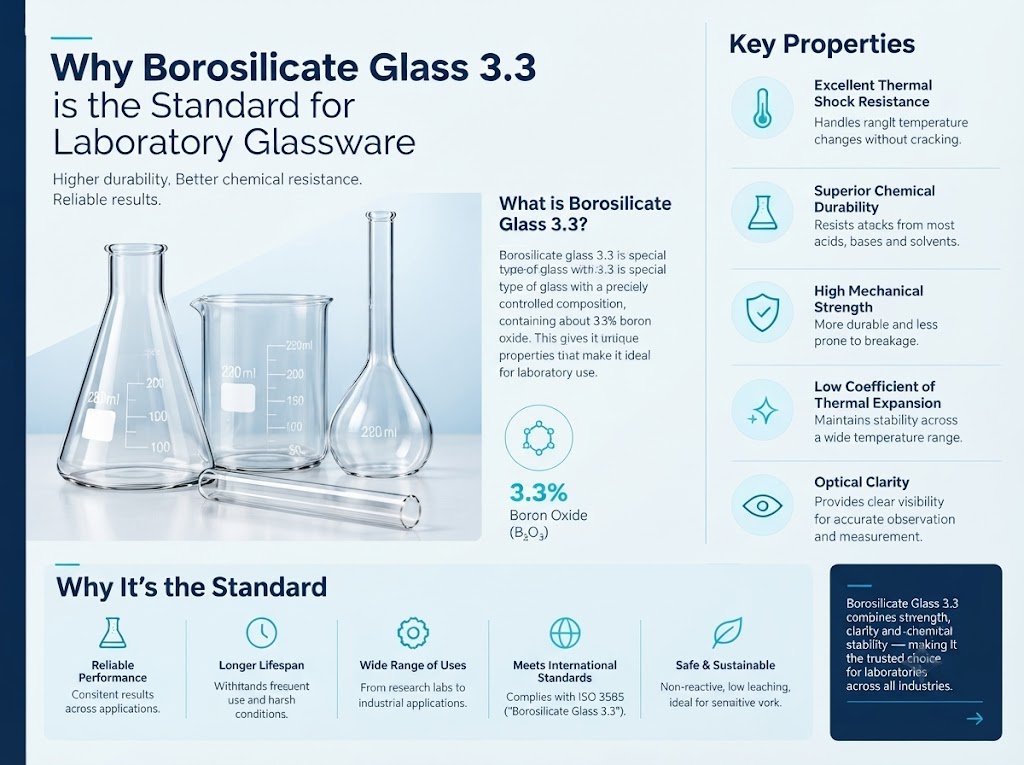
Open any chemistry cupboard in India and most of the beakers, flasks and bottles will be made of the same material: borosilicate glass 3.3. The number is not a model code; it describes how much the glass expands when heated. This article explains what makes this glass suitable for the laboratory, what it cannot do, and how to look after it.
What borosilicate 3.3 is made of
Borosilicate glass contains boron oxide as a major component alongside silica. Borosil Scientific gives the composition of its 3.3 grade as roughly 80.6 % silica (SiO2), 13 % boron oxide (B2O3), 4 % sodium oxide and 2.3 % aluminium oxide [1]. Compared with the higher-expansion borosilicate grades the same company lists (4.9 and 5.4), the 3.3 grade has more boron oxide and less sodium oxide [1].
The meaning of "3.3"
The figure refers to the coefficient of thermal expansion, 3.3 × 10⁻⁶ per kelvin, measured between 20 and 300 °C [1][3]. Borosil Scientific describes 3.3 as the lowest-expansion grade among those it lists (the others are 4.9 and 5.4) [1]. A glass that expands less produces smaller internal stress when one part of the vessel is hotter than another, which is why it copes better with heating on a hot plate or a sudden change in temperature than ordinary glass would. A separate manufacturer, Steroglass, quotes the same property as 32.5 × 10⁻⁷ per °C, which is the same value written differently [2].
Useful temperature points
Annealing point: 565 °C [1][2][3].
Softening point: about 820 °C [1][2].
Density at 25 °C: 2.23 g/cm3 [1].
One supplier recommends a maximum working temperature of 500 °C, for short periods only [3].
These are material properties, not a promise that every piece of glassware can be heated to those limits. Individual items can have their own limits, so follow the maker's instructions. Steroglass notes that heating above 500 °C may leave permanent residual stress after cooling, so repeated high-temperature use of the same piece is best avoided [2].
Chemical resistance
Borosil Scientific states that its borosilicate glass is highly resistant to most chemicals, with hydrofluoric acid, phosphoric acid and hot strong caustic solutions as the exceptions, where quartz is the better material [1]. Steroglass describes resistance to neutral and acidic solutions, including chlorine, bromine, iodine and many organic substances, even during long reactions above 100 °C, and again lists hydrofluoric acid, very hot phosphoric acid and hot concentrated alkali as attackers of the surface [2]. A distributor lists the glass as hydrolytic class HGB 1 under ISO 719 [3]. In practice, this means the glass releases very little into water-based samples, which supports accurate analytical work.
Standards and classifications
Several specifications refer to this glass [1][3]:
ASTM E438: Borosil Scientific classifies its 3.3 glass as Type 1 Class A, while its 4.9 and 5.4 grades are Type 1 Class B [1].
USP and European Pharmacopoeia: all three grades are stated to be Type 1 [1].
ISO 3585: Borosil describes this standard as the one defining glass for laboratory glassware, and states that its chemical glassware complies with it, along with USP Type 1 and ASTM E438 Type 1 Class A [1].
When compliance matters for an audit, ask the supplier for the certificate that covers your batch rather than relying on the general description.
Everyday care
Heat and cool gradually; avoid placing a hot vessel on a cold, wet surface.
Inspect for chips, cracks and star marks before heating, because damaged glass is weaker.
Avoid hydrofluoric acid, hot phosphoric acid and hot strong caustic solutions in glass [1].
Repeated dry and wet sterilisation cycles are normally tolerated by this glass [2], but follow the instructions for each item.
Quick checklist when buying or using
Check that the glass is stated as borosilicate 3.3, not a generic or higher-expansion grade.
Look for the standards stated on the product page or certificate (for example ASTM E438, USP Type 1, ISO 3585).
Check the marked class of volumetric items (A or B) against your method's accuracy needs.
Know your chemistry: avoid hydrofluoric acid, hot phosphoric acid and hot strong caustic solutions in glass.
Inspect before every heating cycle, and discard damaged pieces.
Stay well below the maker's stated temperature limit for each item.
Conclusion
Borosilicate 3.3 is the common choice for laboratory glassware because its low thermal expansion reduces thermal stress, its composition resists most reagents and water, and it is described by recognised classifications used in pharmaceutical and analytical work. It is not indestructible and has specific weaknesses, so use it within the limits given by the manufacturer. This article gives general guidance only; the product certificate and manual are the authority for any individual item.
Sources
- Borosil Scientific - What is Borosilicate Glass? (types, composition and properties) (read 2026-10-20)
- Steroglass - 3.3 Borosilicate glass: a valuable material for scientific and laboratory instruments (read 2026-10-20)
- ProSciTech - Laboratory glassware standards (3.3 borosilicate data) (read 2026-10-20)