
Specification sheet
14 Nov 2026
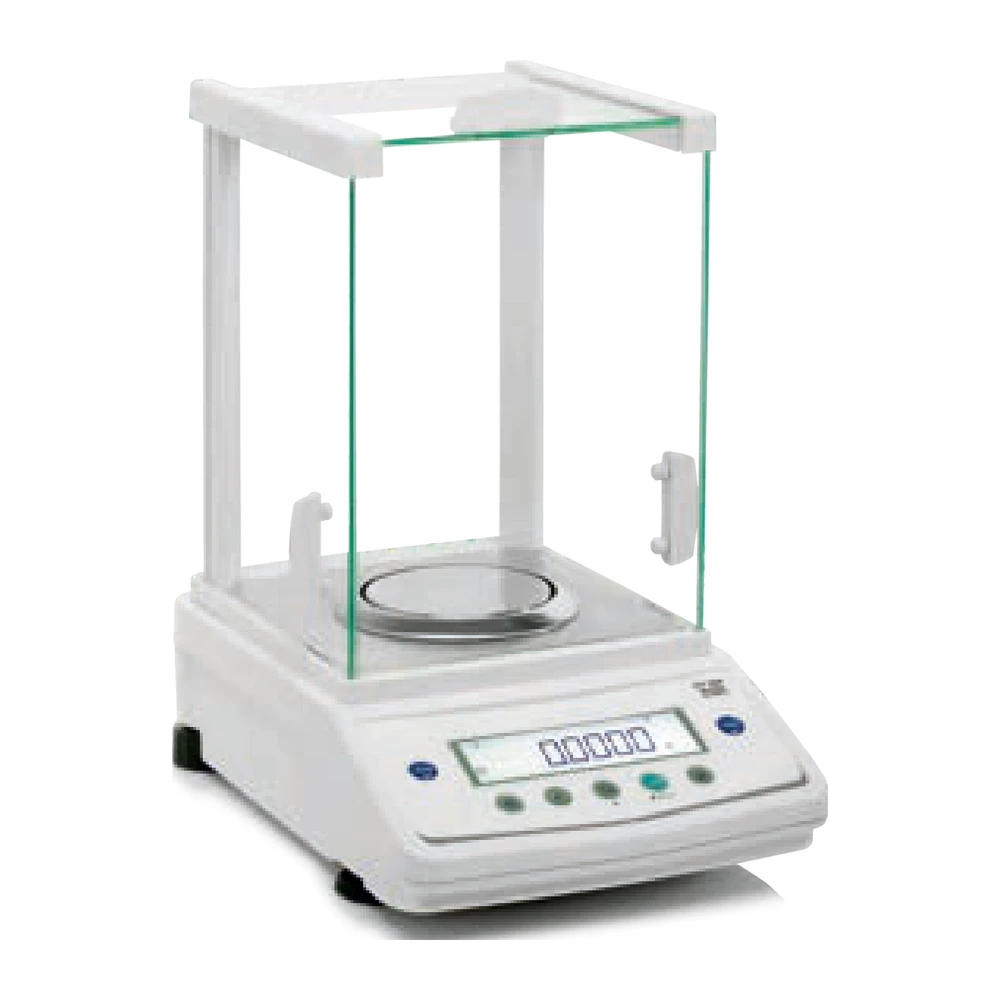
Aczet · Analytical Balance
Aczet CY 224C Analytical Balance 220 g × 0.1 mg
The Aczet CY 224C is an analytical balance with a 220 g capacity and 0.1 mg readability, the classic range for pharma, chemical, food and research labs. It has motorised internal calibration, a 90 mm pan under a three-side-opening glass draft shield, a backlit LCD, RS 232C output (USB optional) and a built-in clock for GLP records. Aczet lists it in its CY-C Professional Level series.
Overview
The Aczet CY 224C Analytical Balance weighs up to 220 g with a readability of 0.1 mg (0.0001 g), which is the capacity and resolution most laboratories look for when they search for a "220 g 0.1 mg analytical balance". It belongs to the Professional Level CY-C series, where the letter C stands for the motorised internal calibration.
Calibration you do not have to think about
Built-in motorised weights calibrate the balance at the press of a key, and the Perfect Self Auto Calibration (PSAC) function repeats the internal calibration when the ambient temperature changes by a set value or after a defined time. That keeps results steady in labs where the temperature moves during the day.
Specifications that matter at the bench
Capacity 220 g, readability 0.1 mg, repeatability 0.1 mg, linearity ± 0.2 mg (Aczet datasheet).
Typical minimum weight 160 mg by the USP 0.1% criterion and 16 mg at U = 1%, so small samples can be weighed with confidence.
Response time of 2 to 3 seconds and a 90 mm diameter pan.
Built for daily laboratory work
The balance has a large backlit LCD, a spacious glass draft shield that opens on three sides, easy levelling with a bubble indicator and a capacity tracker on the display that helps you avoid overloading the weighing cell. Eleven built-in applications include piece counting, percentage weighing, formulation, check weighing, density determination and statistics, and a below-balance weighing hook is provided. A built-in clock supports ISO / GLP / GMP documentation, and the RS 232C interface (USB optional) connects a printer or PC.
Who it suits
Aczet names food, pharma, chemical, cosmetic, polymer, cement and testing laboratories as typical users. If you need 120 g or 320 g instead of 220 g, the same CY-C series covers them. Tell our team about your application and we will confirm the right model for you.
Technical specifications
| Model | CY 224C |
|---|---|
| Weighing capacity (g) | 220 |
| Readability (mg) | 0.1 |
| Minimum load (mg) | 10 |
| Repeatability, sd (mg) | 0.1 |
| Linearity (mg) | ± 0.2 |
| Tare range, subtractive (g) | -220 |
| Minimum weight, USP 0.1%, typical (mg) | 160 |
| Minimum weight, U = 1%, typical (mg) | 16 |
| Pan size (mm) | Ø 90 |
| Response time (sec.) | 2 to 3 |
| Display | Alphanumeric backlit LCD |
| Calibration and adjustment | Motorised internal calibration |
| Units | gm, mg, ct, GN, mo, oz, dwt, t1T, t1H, t1S, mom, Bat, MS |
| Operating temperature (°C) | 18 to 30 |
| Sensitivity drift (ppm/°C) | ± 2 (2 × 10⁻⁶ / °C) |
| Interface | RS 232C, USB optional (Windows direct communication) |
| Application modes | PCS, % weighing, animal / dynamic weighing, check weighing, automatic density determination, formulation, automatic statistic calculator |
| Power supply | DC adapter, input 100 to 240 V / 0.8 A, output 13 V / 1.5 A, 50 / 60 Hz |
| Compliance | ISO, GLP / GMP and USP |
| Balance size, W × D × H (mm) | 342.5 × 212 × 341 (chamber height: 239.5) |
| Weight, approx. (kg) | 9.3 |
Key features
- 220 g × 0.1 mg The standard analytical range: 220 g capacity with 0.1 mg readability.
- Motorised internal calibration Built-in weights calibrate the balance at a keypress; PSAC repeats it when temperature or time changes.
- Three-side-opening draft shield A spacious glass shield with a 90 mm pan keeps air currents off the sample.
- Clear backlit LCD Easy to read in any room lighting, with a capacity tracker to avoid overloads.
- GLP-ready output Built-in clock and RS 232C interface (USB optional) for traceable records.
Key advantages
- Fewer manual calibrations PSAC recalibrates after a temperature change or a set time, so you spend less time with test weights.
- Small samples welcome Typical minimum weight is 160 mg (USP 0.1%) and 16 mg at U = 1%.
- Many weighing jobs in one balance Counting, percentage, check weighing, density, formulation and statistics are built in.
- Easy to keep clean The draft shield parts can be taken apart and put back, so cleaning is simple.
- Below-balance weighing A hook lets you weigh objects that do not sit on the pan.