Nitrogen and Protein Analysis: Dumas Combustion vs Kjeldahl
Both methods measure nitrogen and convert it to protein, but they differ in speed, reagents and results. A balanced look to help you choose and report correctly.
Protein content on a food or feed label is rarely measured directly. Instead, laboratories measure total nitrogen and multiply by a conversion factor. Two methods dominate: the classical Kjeldahl method and the Dumas combustion method. This article compares them fairly, including where each has limits. It is general guidance, not a replacement for the standard that your customer or regulator specifies.
How the Kjeldahl method works
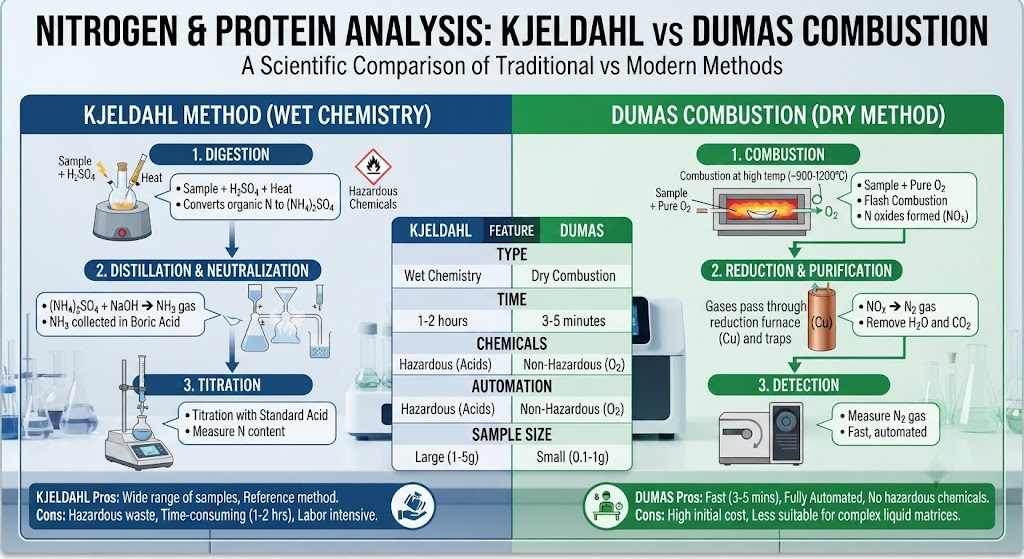
Kjeldahl was developed in 1883 and remained the standard for a very long time [1][3]. The sample is digested with concentrated sulfuric acid and a catalyst at high temperature (the digestion is described as running at roughly 360-410 °C), which converts organic nitrogen into ammonium. Sodium hydroxide is then added, the ammonia is distilled into an acid trap, and the amount captured is determined by titration [4]. It measures organic and ammonia nitrogen and, in its basic form, does not capture nitrate or some ring-structured nitrogen compounds [3][4].
How the Dumas (combustion) method works
In the Dumas method the sample is burned at high temperature in oxygen. Nitrogen oxides are reduced to nitrogen gas, other combustion gases are trapped or separated, and a thermal conductivity detector measures the nitrogen [1][3]. LECO states that its FP828 and FP928 analysers give a result in under three minutes per sample on the FP828, and that sample masses up to 2 grams can be used [1][2]. There is no wet digestion step, so no acid digestion or distillation is needed [1][5].
Time, chemicals and waste
Time. A FOSS white paper puts Dumas at a few minutes per measurement against an hour or more for Kjeldahl [3]; LECO says a Kjeldahl run can take hours [1].
Chemicals. Kjeldahl uses concentrated sulfuric acid, a catalyst, and strong base [4][5]. Wikipedia lists selenium and mercury-based catalysts among those used, and notes that titanium dioxide is the approved catalyst in AOAC protein methods [4]. LECO adds that the most efficient catalysts were phased out for safety and environmental reasons, which can lower nitrogen recovery if they are not replaced adequately [1].
Automation and labour. Combustion analysers are easier to automate and need little operator input [3]. Both are vendor statements, so confirm with your own workload.
Do they give the same answer?
Often close, but not identical. Dumas measures total nitrogen, including inorganic forms such as nitrate and nitrite, while Kjeldahl measures organic and ammonia nitrogen and does not fully recover some compounds. Because of this, Dumas results are usually a little higher [3][5]. In AAFCO feed proficiency samples quoted by FOSS, one chicken feed sample read 17.29% crude protein by Kjeldahl and 17.64% by Dumas, with comparable scatter between labs [3].
Neither method measures true protein: both register non-protein nitrogen, so adulterants rich in nitrogen can inflate the result [3][4].
Conversion factors and official methods
Nitrogen is converted to protein with a factor. A general factor of 6.25 is agreed for most foods and feeds, while ISO/TS 16634-2 gives 5.7 for wheat, rye and their milled products [3]. Using the same factor for both techniques is common practice, which is one reason differences between methods can appear [3].
Standards exist for both approaches. Dumas methods are listed in ISO, AOAC, AOCS and other standards for food and feed [3]. However, the same white paper notes that the European Commission confirmed Kjeldahl as the community method for official feed controls (Regulation (EC) No 152/2009), and where Kjeldahl is the official method Dumas can be used only if the differences for your sample type are negligible [3]. Check which method your customer or regulator names.
Quick checklist
Confirm which method or standard the specification requires.
State the method and the conversion factor on every report.
Do not mix Kjeldahl and Dumas results in one trend without checking the offset for your matrix.
Consider nitrate-rich or unusual samples (such as vegetables), where results can differ more [3].
If you keep Kjeldahl, plan fume extraction, acid handling and waste disposal.
If you move to Dumas, run a comparison on your own typical samples first.
Conclusion
Dumas combustion is faster and avoids wet-chemistry reagents, while Kjeldahl remains a recognised reference in many official settings. Neither is simply "better": the right choice depends on your samples, throughput, safety setup and what the specification demands. Before switching, validate on your own materials and report the method clearly.
Sources
- LECO - Kjeldahl vs Dumas: Determining Protein (read 2026-10-20)
- LECO - Protein Analysis Instruments for Nitrogen Determination (read 2026-10-20)
- FOSS white paper - Dumas or Kjeldahl for reference analysis? (2017) (read 2026-10-20)
- Wikipedia - Kjeldahl method (read 2026-10-20)
- VELP - Dumas and Kjeldahl method comparison: protein determination in feed (read 2026-10-20)